
NONNA PIDVALNA

NONNA PIDVALNA
is an American artist of Ukrainian origin who has lived and worked in New York since 2011.
Nonna Pidvalna is an American artist of Ukrainian origin who has lived and worked in New York since 2011.
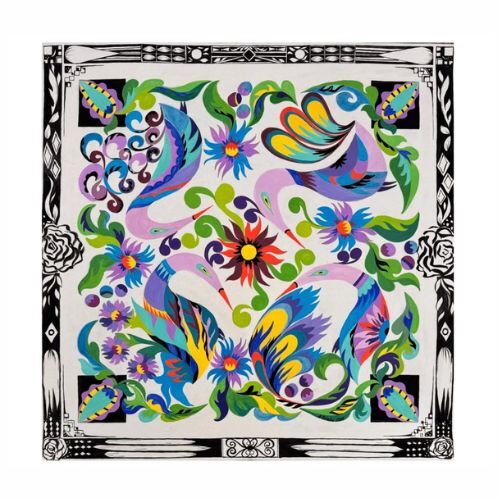
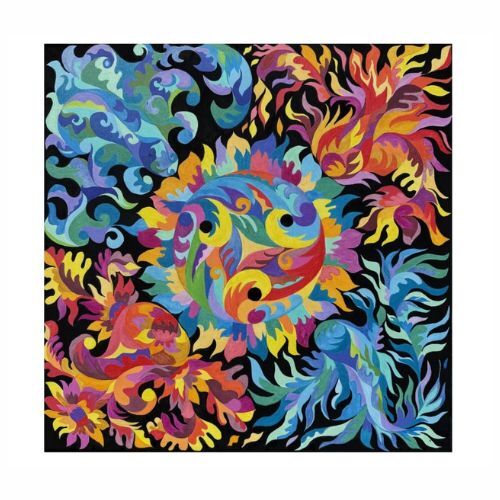
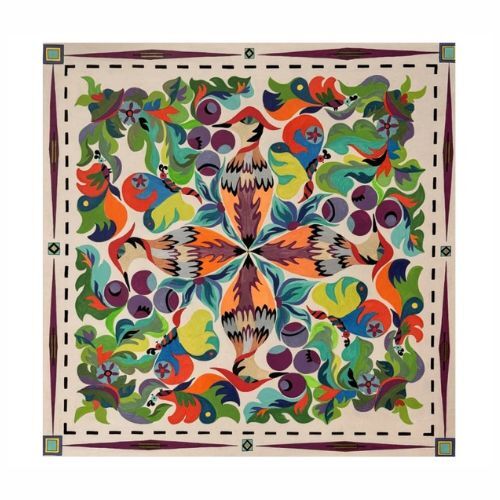
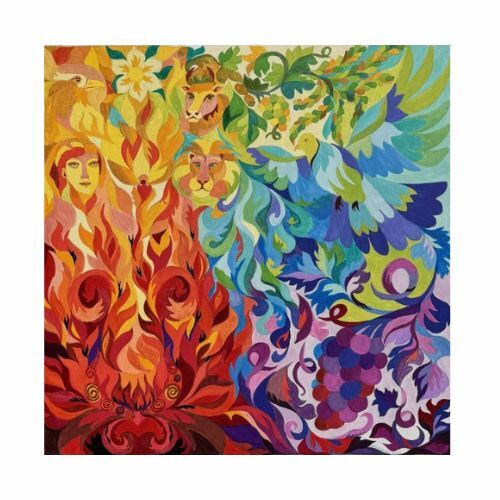
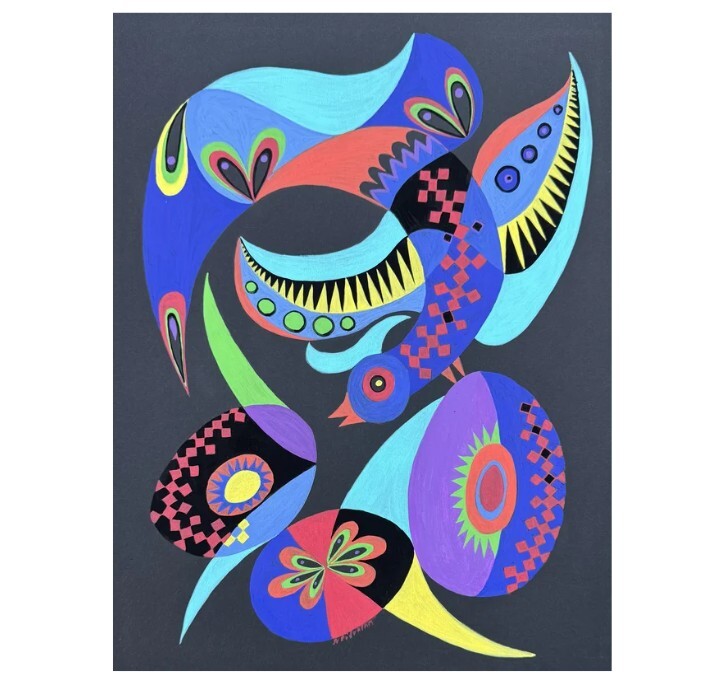
In her practice, she combines elements of Ukrainian folk tradition with a contemporary visual language. Having grown up in a cultural environment where ornament and handcraft were integral to everyday visual experience, she approaches folk art not as a decorative form but as a resilient system of signs and rhythms.
Her experience of emigration, life in New York, and immersion in a multilingual cultural environment have shaped Pidvalna’s sensitivity to space, structure, and visual discipline. Her artistic method developed through both independent studio practice and formal training in the workshops of Alexander Kedrin and Oxana Sanson, as well as through international programs, including the International Samchykivka Painting School of Olha Mashevska and Art Communication Online School by Julia Sysalova/Institute of Mediterranean Culture.
Since 2025, Samchykivka folk painting has become a central element of her practice, reinterpreted as a language of memory and inner balance. In her work, ornamental structures function as visual principles of stability and meditative focus ... read more
In her practice, she combines elements of Ukrainian folk tradition with a contemporary visual language. Having grown up in a cultural environment where ornament and handcraft were integral to everyday visual experience, she approaches folk art not as a decorative form but as a resilient system of signs and rhythms.
Her experience of emigration, life in New York, and immersion in a multilingual cultural environment have shaped Pidvalna’s sensitivity to space, structure, and visual discipline. Her artistic method developed through both independent studio practice and formal training in the workshops of Alexander Kedrin and Oxana Sanson, as well as through international programs, including the International Samchykivka Painting School of Olha Mashevska and Art Communication Online School by Julia Sysalova/Institute of Mediterranean Culture.
Since 2025, Samchykivka folk painting has become a central element of her practice, reinterpreted as a language of memory and inner balance. In her work, ornamental structures function as visual principles of stability and meditative focus ... read more
More artworks
More artworks
BIO
Nonna Pidvalna is an American artist of Ukrainian origin who has lived and worked in New York since 2011.
In her practice, she combines elements of Ukrainian folk tradition with a contemporary visual language. Having grown up in a cultural environment where ornament and handcraft were integral to everyday visual experience, she approaches folk art not as a decorative form but as a resilient system of signs and rhythms.
Her experience of emigration, life in New York, and immersion in a multilingual cultural environment have shaped Pidvalna’s sensitivity to space, structure, and visual discipline. Her artistic method developed through both independent studio practice and formal training in the workshops of Alexander Kedrin and Oxana Sanson, as well as through international programs, including the International Samchykivka Painting School of Olha Mashevska and Art Communication Online School by Julia Sysalova/Institute of Mediterranean Culture.
Since 2025, Samchykivka folk painting has become a central element of her practice, reinterpreted as a language of memory and inner balance. In her work, ornamental structures function as visual principles of stability and meditative focus.
Between 2018 and 2026, Nonna Pidvalna actively participated in exhibitions in New York, New Jersey, Long Island, and California and became a member of several art communities, including the South Bay Art Association, Old Town Arts Guild, and Wurtsboro Art Alliance Gallery.
Her works are held in private collections in the United States and Europe.
Nonna Pidvalna is an American artist of Ukrainian origin who has lived and worked in New York since 2011.
In her practice, she combines elements of Ukrainian folk tradition with a contemporary visual language. Having grown up in a cultural environment where ornament and handcraft were integral to everyday visual experience, she approaches folk art not as a decorative form but as a resilient system of signs and rhythms.
Her experience of emigration, life in New York, and immersion in a multilingual cultural environment have shaped Pidvalna’s sensitivity to space, structure, and visual discipline. Her artistic method developed through both independent studio practice and formal training in the workshops of Alexander Kedrin and Oxana Sanson, as well as through international programs, including the International Samchykivka Painting School of Olha Mashevska and Art Communication Online School by Julia Sysalova/Institute of Mediterranean Culture.
Since 2025, Samchykivka folk painting has become a central element of her practice, reinterpreted as a language of memory and inner balance. In her work, ornamental structures function as visual principles of stability and meditative focus.
Between 2018 and 2026, Nonna Pidvalna actively participated in exhibitions in New York, New Jersey, Long Island, and California and became a member of several art communities, including the South Bay Art Association, Old Town Arts Guild, and Wurtsboro Art Alliance Gallery.
Her works are held in private collections in the United States and Europe.
ARTIST'S STATEMENT
My work begins with an inner search, a continuing attempt to understand what remains true beneath the noise, speed, and demands of everyday life. Painting gives this search a visible form. Through color, rhythm, symbol, and ornament, I bring separate thoughts and images into relationship and allow a composition to develop its own internal order.
My paintings are vivid and layered because I experience life as layered. Each element is chosen for a reason, and meaning often emerges through the way forms repeat, answer one another, or change within the composition. Ornament helps me hold these relationships together. It guides the eye, creates rhythm, and gives structure to ideas that may be expressed through words but are experienced differently through an image.
My work is shaped by Judeo-Christian tradition, reverence for the Creator, Ukrainian Samchykivka painting, folk art, cultural memory, the Glasgow Style, Art Nouveau, and the geometric language of the Vienna Secession and Wiener Werkstätte. I am drawn to traditions in which beauty, belief, daily life, and symbolic form remain closely connected. The experiences of women also occupy an important place in my work: their strength, vulnerability, inherited memory, invisible labor, and ability to preserve meaning through periods of disruption. Emigration has deepened this inquiry. Living between cultures has made me more attentive to what is carried, what is transformed, and what remains after familiar structures are left behind.
Historical and traditional elements enter my paintings as active sources. I study them, respond to them, and place them within compositions shaped by my own experience as a woman and an emigrant. In this way, my work becomes part of a continuing conversation between inherited forms and the present, between cultural memory and personal transformation.
The paintings ask for time and attention. They create a place where the eye can move slowly, connections can unfold, and reflection can begin.
My work begins with an inner search, a continuing attempt to understand what remains true beneath the noise, speed, and demands of everyday life. Painting gives this search a visible form. Through color, rhythm, symbol, and ornament, I bring separate thoughts and images into relationship and allow a composition to develop its own internal order.
My paintings are vivid and layered because I experience life as layered. Each element is chosen for a reason, and meaning often emerges through the way forms repeat, answer one another, or change within the composition. Ornament helps me hold these relationships together. It guides the eye, creates rhythm, and gives structure to ideas that may be expressed through words but are experienced differently through an image.
My work is shaped by Judeo-Christian tradition, reverence for the Creator, Ukrainian Samchykivka painting, folk art, cultural memory, the Glasgow Style, Art Nouveau, and the geometric language of the Vienna Secession and Wiener Werkstätte. I am drawn to traditions in which beauty, belief, daily life, and symbolic form remain closely connected. The experiences of women also occupy an important place in my work: their strength, vulnerability, inherited memory, invisible labor, and ability to preserve meaning through periods of disruption. Emigration has deepened this inquiry. Living between cultures has made me more attentive to what is carried, what is transformed, and what remains after familiar structures are left behind.
Historical and traditional elements enter my paintings as active sources. I study them, respond to them, and place them within compositions shaped by my own experience as a woman and an emigrant. In this way, my work becomes part of a continuing conversation between inherited forms and the present, between cultural memory and personal transformation.
The paintings ask for time and attention. They create a place where the eye can move slowly, connections can unfold, and reflection can begin.
CV